If you’re staying around Grado and fancy swapping the beach for a bit of Roman history, Aquileia makes a surprisingly easy family outing.
We visited from Club del Sole Tenuta Primero Grado Family Resort, and the drive took us roughly 20 minutes. We’d deliberately left fairly early. It was summer, it was going to get hot, and wandering around Roman ruins with two children in the midday Italian sun didn’t sound like anyone’s idea of a good time.
Breakfast could wait.
Or at least that was the theory.
💡 If you’re using Grado as your base, take a look at our complete guide to visiting Grado with kids, including beaches, food, things to do and more ideas for exploring the area as a family.
The drive from Grado to Aquileia
The drive to Aquileia was actually part of the experience.
Once we left the coast around Grado, we were soon travelling through the flat agricultural countryside of Friuli Venezia Giulia.
We visited in early September, right in the middle of harvest time. Combines were working in the fields, maize was being harvested and there were tractors and trucks moving around the countryside.
I actually drove through Aquileia again a couple of days later on my way towards Villesse to buy a new camera, and noticed it even more that time. There were combines working beside the road and plenty going on in the fields.
It’s quite a contrast to Grado. One minute you’ve got beaches, boats and the lagoon; a short while later you’re driving through working farmland watching the harvest.
The roads are reasonably easy, although some sections are fairly narrow. Nothing particularly difficult, but it’s worth taking your time and keeping an eye out for trucks and agricultural machinery.
For us, it meant even the short drive felt like part of the outing rather than simply a way of getting there.

Arriving and parking in Aquileia
We found a car park almost directly opposite the Aquileia tourist information centre, and there was plenty of space available on the morning we visited.
It was paid parking.
That sounds simple enough.
It wasn’t always.
Paying for parking became one of those surprisingly recurring puzzles during our travels in Italy. We’d find a park easily enough, then spend the next few minutes standing in front of a machine trying to decipher exactly what it wanted us to do.
We weren’t alone.
At another Italian car park we met a Norwegian traveller having exactly the same problem. He’d eventually stumbled across a parking app that worked and was trying to make sense of the whole thing himself.
One app worth having on your phone before travelling in Italy is EasyPark. It works across more than 800 Italian cities, although you should always check the app to make sure the particular parking zone you’re standing in is supported.
There’s normally a service charge for using it, so it isn’t necessarily the cheapest way to park. But when you’re standing beside an unfamiliar parking machine with children waiting to get going, paying a small fee for convenience suddenly doesn’t seem quite so unreasonable.
Otherwise, give yourself an extra five minutes and have a translation app ready on your phone. Pointing your camera at an Italian parking machine and translating the instructions is considerably easier than pressing buttons and hoping for the best.
Start at the tourist information centre
Our first proper stop was the Aquileia tourist information centre.
I’d recommend making this your first stop too.
The staff gave us a map showing the main archaeological sites and numbered stops around Aquileia. After that, we basically just went for a wander.
That turned out to be about all the planning we needed.
Aquileia isn’t somewhere where you necessarily need to march from attraction to attraction with a strict itinerary. Much of the enjoyment comes from walking through the town and suddenly finding yourself alongside something that’s been sitting there for a couple of thousand years.
There is one thing I’d mention if you’re visiting with young children: keep an eye on them around the roads.
Some of the footpaths are narrow and, based on our experience, an Italian pedestrian crossing doesn’t necessarily possess the same magical car-stopping powers that a New Zealand pedestrian crossing does.
We learned fairly quickly not to assume a car was going to stop just because we were standing at one.
First priority: croissants
Because we’d skipped breakfast to beat the heat, we made an early detour to a small café right beside the car park and grabbed a couple of takeaway croissants for the girls.
This proved to be an excellent investment in family harmony.
Croissants dealt with, map in hand, we started walking.
The Candia Mausoleum
One of the first structures that caught our attention was the enormous Candia Mausoleum.
Interestingly, what you’re looking at isn’t a Roman tomb that has stood intact on this exact spot for 2,000 years.
Fragments of the original Roman funerary monument were discovered outside the ancient city, and the mausoleum was reconstructed in Aquileia in the 1950s.
It’s an impressive structure regardless, and it gives you an immediate sense that Aquileia isn’t going to be a normal walk around a small Italian town.
From there we continued towards the Roman remains.


Walking on Aratria Galla’s Roman road
One of my favourite parts of Aquileia sounds almost ridiculously simple.
We walked down a road.
Admittedly, it was a Roman one.
The Decumanus of Aratria Galla is a surviving section of an ancient paved street that once formed part of Roman Aquileia.
But I found the woman whose name is attached to it almost as interesting as the road itself.
Aratria Galla appears to have come from a prominent Aquileian family connected with the city’s building and entrepreneurial world.
Exactly where her own wealth came from isn’t known, and I’m not going to pretend otherwise.
What we do know from the surviving inscriptions is that Aratria Galla was responsible for having this important road paved, apparently through instructions contained in her will.
And that’s the detail that suddenly made this pile of old stones much more interesting to me.
Nearly 2,000 years later, our daughters were walking along them.
There’s something quite different about actually walking along an ancient street rather than simply looking at ruins from behind a barrier.
The girls could walk across the old stones. We could imagine carts, merchants and ordinary residents travelling through the same area all those centuries before us.
Those are the bits of history that seem to work particularly well with children.
Dates and emperors can be difficult to comprehend.
Walking down somebody’s street isn’t.

The Roman river port was the highlight for us
We eventually made our way towards Aquileia’s ancient river port, and this was probably my favourite archaeological area of the visit.
It’s difficult to appreciate the scale of the place at first because, of course, the river isn’t sitting there full of Roman boats anymore.
But this was once a major working port.
You can still see the remains of the quays, loading areas, ramps and structures used when goods and people were moving through Aquileia.
Once you start understanding what you’re looking at, it’s fascinating.
The information boards along the route helped enormously. We found them clear and informative, and the ones we stopped to read included information in multiple languages, including English and German.
A bonus for families travelling on a budget is that you don’t need to buy a ticket simply to explore the river port and several of Aquileia’s other outdoor archaeological areas.
This was also where my wife and daughter spotted something considerably more alive than the Roman ruins.
A snake.
I’ve barely seen a snake in the wild in my life, so naturally by the time they told me about it I wanted to see it.
I went back looking.
The snake, apparently unimpressed by my enthusiasm, had disappeared.

Aquileia is still being uncovered
Another interesting part of our visit was seeing how much archaeological work is still happening.
There were people working around some of the sites, with sections fenced off while excavation and restoration work was underway.
From a photography point of view, the wire fencing isn’t ideal.
Some sections inevitably looked a little more like an active construction site than the untouched Roman city you might have pictured beforehand. We could still see almost everything, though, and sometimes getting a clear photo simply meant lifting the phone above the fencing.
But there’s another way of looking at it.
Aquileia isn’t a finished museum.
People are still excavating, studying, restoring and conserving it.
Seeing that happening actually made the place more interesting to me. This isn’t history that was discovered a century ago, labelled and forgotten.
They’re still working on it.
Walking towards the Basilica
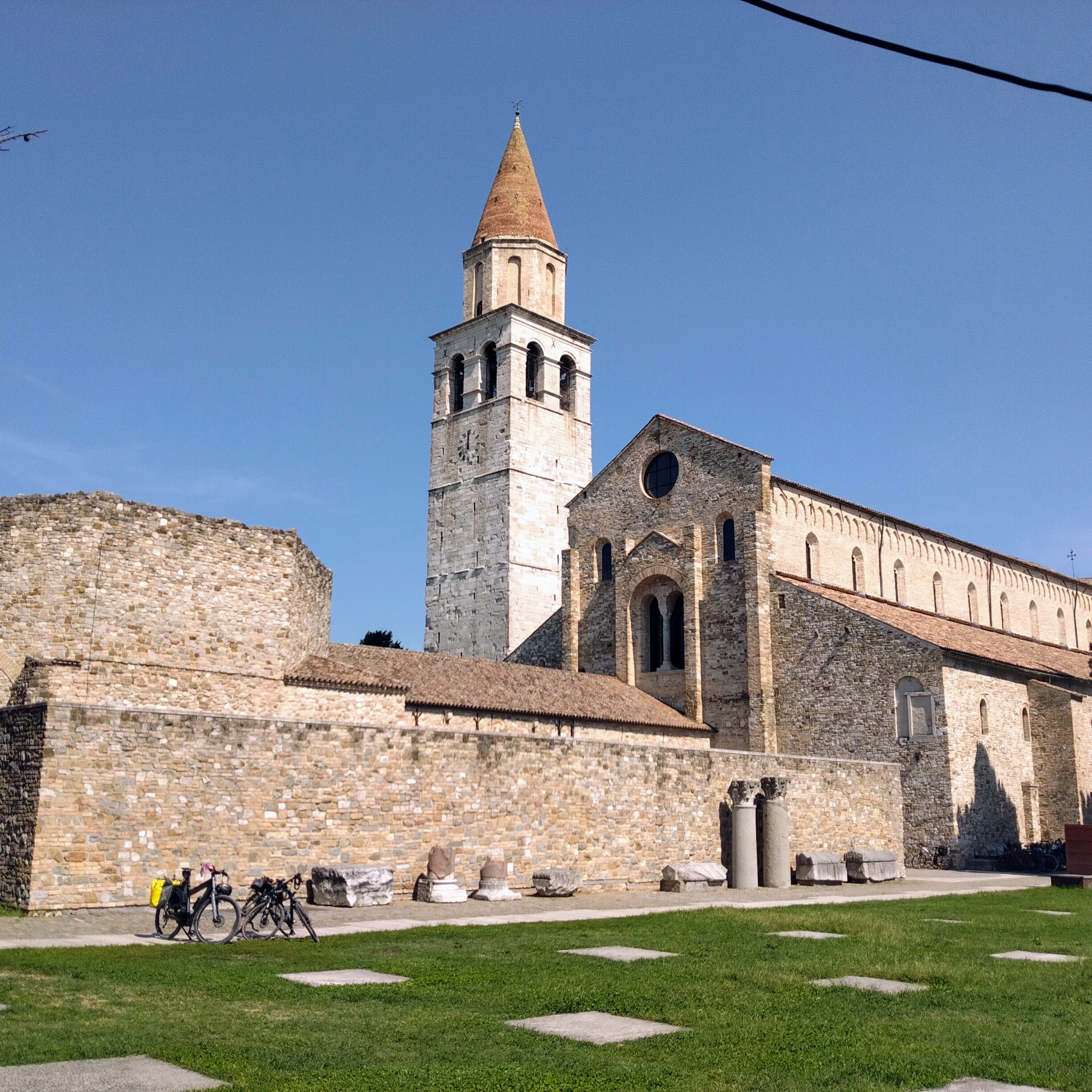
From the old port area we continued towards the Basilica.
After exploring the low remains of Roman streets, buildings and the old port, you gradually find yourself approaching a completely different chapter of Aquileia’s history.
And then you see the Basilica and its enormous bell tower.
It’s hard not to be impressed.

The war cemetery – an unexpected history lesson
Near the Basilica is the First World War cemetery.
Our older daughter was quite affected by it.
It led to one of those conversations you don’t necessarily plan to have while you’re on holiday – explaining why the graves were there, what had happened and why so many people had died.
She found it sad.
So did we.
But that’s one of the things I like about travelling with children. Sometimes history stops being something in a schoolbook and becomes something they can actually see.
We didn’t spend a huge amount of time there, but it became one of the more memorable parts of the morning for a completely different reason from the Roman ruins.


The Basilica of Aquileia
Then you reach the Basilica itself.
Even without going inside, it’s impressive.
The Basilica, huge bell tower and surrounding buildings completely change the feel of the area. After spending the previous hour among Roman roads, ruins and the remains of the old port, suddenly you’re standing beside this enormous religious complex.
We decided not to pay for entry on this visit.
With two children, other family members with us and a limited amount of time, we felt we’d already had a brilliant morning exploring the outdoor sites.
We could still walk up and get a glimpse inside and see some of the famous mosaics, which gave us a taste of what was there.
If we’d had more time, I’d have liked to go inside properly.
As of our visit in 2026, the combined adult ticket costs €12, while visitors under 18 are free.
Importantly, that ticket covers considerably more than simply walking into the Basilica. It includes the Basilica and its extraordinary fourth-century mosaics, the crypts, baptistery and South Hall, the Domus and Bishop’s Palace, and the Domus of Titus Macro.
For a family with children under 18, that’s actually considerably better value than we’d realised at the time.
It’s one thing I’d probably do differently on another visit.


A late breakfast beside the Basilica
By this point our emergency croissants had done their job, but everyone was ready for something more substantial.
We stopped at a café beside the Basilica called Pasticceria Mosaico, which sold a range of sweet and savoury croissants and sandwiches, and platters. There was a pizza place just next door also.
The food was excellent once it arrived.
They had platters as well as filled rolls, croissants and various sweet and savoury options, making it an easy place to find something everyone wanted.
The service was another matter.
There appeared to be one young waitress dealing with what felt like approximately half the population of Aquileia.
She was clearly run off her feet, so I don’t entirely blame her, but getting someone’s attention became something of a competitive sport.
Sitting politely and hoping someone would eventually notice us wasn’t getting us very far.
Eventually we resorted to the technique we’d been developing throughout our Italian trip:
Wave enthusiastically until someone notices you.
It took a while, but the food was genuinely delicious when it eventually arrived.
How long do you need in Aquileia?
We spent roughly two and a half hours in Aquileia, and for our family that was about right.
It gave us enough time for a relaxed walk through several of the major outdoor archaeological sites, the Roman road, river port, Basilica area and a café stop.
We didn’t visit the inside of the Basilica or the National Archaeological Museum.
If you want to explore those as well, I’d allow at least half a day. If you’re particularly interested in Roman history, you could easily spend longer.
For us, though, around two to three hours worked really well.
It also makes Aquileia particularly easy to combine with a Grado holiday. You can spend the morning exploring Roman ruins and still be back at the beach or pool later in the day.


Want to make a full day of it?
There’s plenty more to do if two or three hours isn’t enough.
You could add the National Archaeological Museum and the full Basilica complex, or look at one of the guided tours available in Aquileia.
If you’re spending more time around both Aquileia and Grado, it’s also worth checking the FVGcard Aquileia & Grado. At the time of writing in 2026, the 48-hour card costs €20 for an adult plus one child or young person under 18 and includes participating attractions and guided-tour benefits.
During summer, another option is to combine Aquileia with the Grado Lagoon.
Seasonal boat trips operate around the lagoon, including excursions to the island of Barbana, while other experiences around Grado range from lagoon tours to guided activities.
If you’re planning your trip in advance, it’s worth checking what is running for your particular dates, as many of these activities are seasonal.
We also normally check GetYourGuide when planning trips to see whether there are any worthwhile tours or experiences available.
Check For Local Tours and Activities Here
I wouldn’t book an activity simply for the sake of filling the day, though.
Aquileia works perfectly well as the easy two-to-three-hour trip that we did.
Is Aquileia worth visiting with kids?
Absolutely.
I wasn’t sure beforehand how interested our girls would be in walking around archaeological ruins, but Aquileia works well because you’re not simply moving through rooms looking at objects behind glass.
You’re walking through the history.
They could walk on a Roman road, explore the remains of an ancient port, see archaeological work happening, stand beside an enormous Basilica and – in our case – apparently spot a snake that Dad wasn’t quick enough to see.
There’s enough space and variety that it didn’t feel like dragging the children around a museum.
My biggest tip would simply be to go early in summer.
There are shaded sections, but a lot of the archaeological areas are exposed. We were very pleased we’d skipped breakfast and got moving before the real heat arrived.
Comfortable shoes are useful, take plenty of water and sun protection, and if you’re travelling with younger children I’d keep them close around the roads and pedestrian crossings.
💡 Travelling with younger kids? A few simple activities can make historical sites much more interesting when little legs start getting tired. Our Family Adventure Pack includes scavenger hunts, observation games, drawing challenges and travel activities designed for kids aged 4–10.
Would we visit Aquileia again?
Yes.
Aquileia turned out to be one of those outings that didn’t require a huge amount of planning, didn’t take an entire day and gave us far more than we’d expected.
I’d happily return, particularly to go inside the Basilica and spend more time exploring some of the areas we only briefly visited.
But I also liked the way we did it the first time.
We didn’t arrive with a huge checklist.
We picked up a map, bought the girls some croissants and started walking.
A couple of hours later we’d walked down a Roman road, explored a 2,000-year-old port, missed a snake, talked to our daughter about the First World War, stood beneath an enormous bell tower and eventually managed to attract the attention of a very busy waitress.
Not bad for a morning away from the beach.
If you’re staying in Grado – particularly around Tenuta Primero – Aquileia is an easy family trip to add to your holiday.
And after several days of swimming, beaches, pools and gelato, walking down a Roman road makes a pretty good change of scenery.
Aquileia with kids: quick guide
Where: Aquileia, Friuli Venezia Giulia, northern Italy
From Tenuta Primero: Around 20 minutes by car based on our visit
How long we spent: Around 2½ hours
How long we’d recommend: 2–3 hours for a relaxed outdoor visit; half a day or more if you want to explore the Basilica complex and museum
Best time in summer: Morning or later afternoon to avoid the worst heat
Good with children? Yes – particularly the outdoor archaeological areas
First stop: Tourist information centre for a map
Parking: We used paid parking opposite the information centre. Allow a few extra minutes to work out payment
Useful parking app: EasyPark has extensive coverage in Italy, but check whether your particular parking zone is supported
Outdoor archaeological sites: Several major areas, including the Roman Forum and river port, are free to enter
Basilica complex: €12 adult combined ticket in 2026; under-18s free
FVGcard Aquileia & Grado: Worth investigating if you’re planning multiple attractions over 48 hours
Our favourite part: Walking through the Roman river port and along Aratria Galla’s ancient road
Take: Water, sun protection, comfortable shoes and a translation app on your phone
One thing to watch: Narrow footpaths and traffic when walking with younger children
And apparently: Snakes. Although everyone in our family seems considerably better at finding them than I am.

